The Support Bot Had The Keys
On Instagram account recovery, automated help desks, and the old mistake of trusting the thing that saves payroll
The part that made my jaw tighten was the button.
The VPN, the high-value handles, the Telegram bragging: all familiar inventory in the account-theft economy, the same stale basement air with different lighting.
The button was the new ugliness.
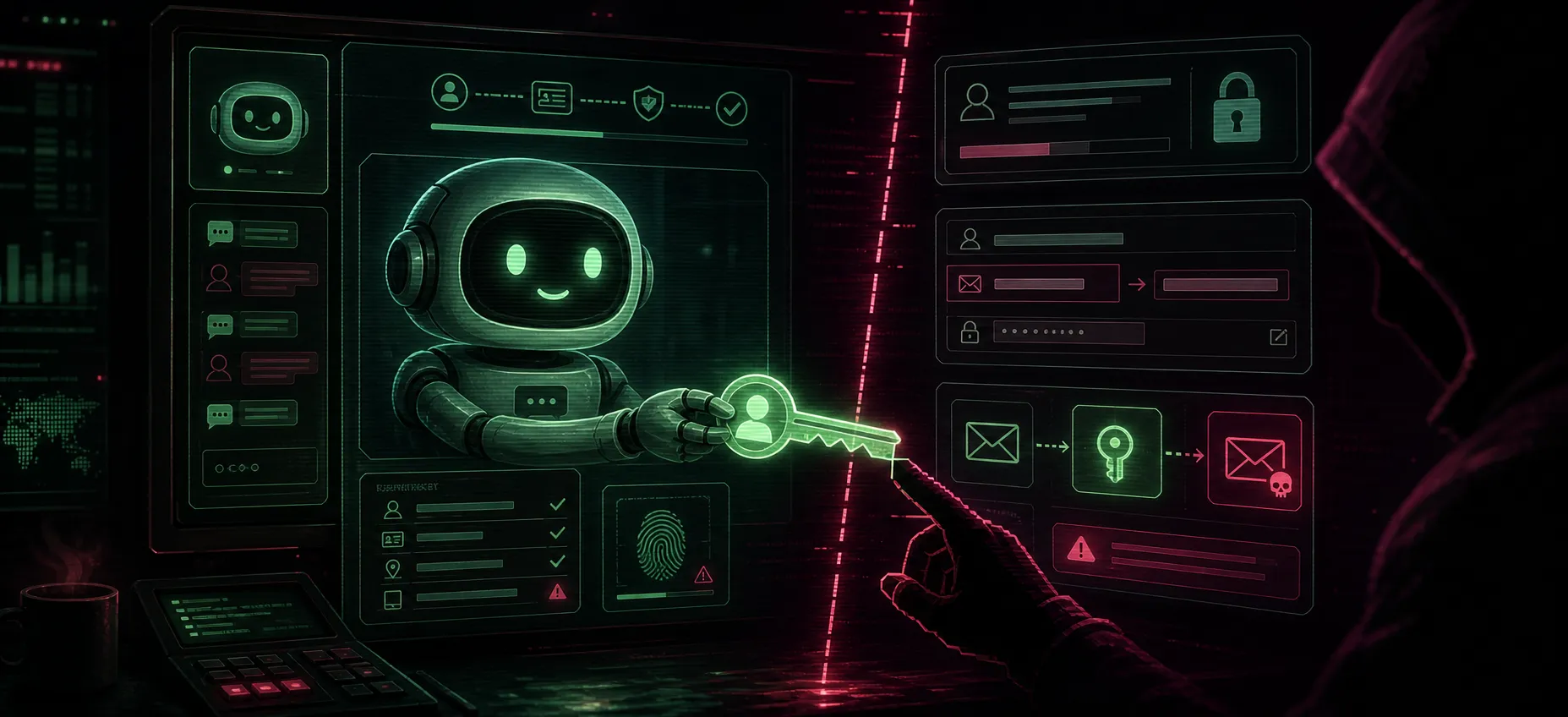
I was sitting at the desk in the bright middle of the afternoon, coffee still warm for once, reading TechCrunch’s account of the Instagram hijacks. The attacker allegedly spoofed the target’s rough location with a VPN, opened Meta’s AI Support Assistant, asked it to add a new email address to the victim’s account, received a verification code at the attacker’s own inbox, handed that code back to the bot, and then got shown a reset-password button.
Click.
Account gone.
That is the whole ugly chain. The victim’s email stayed intact. The phone stayed in their pocket. No SIM swap. No dazzling exploit with a logo and a conference talk. A support system had enough permission to touch identity, and too little resistance at the exact moment it mattered.
The bot did customer support.
That was the problem.
The Help Desk Became A Door
Account recovery is one of the nastiest corners of consumer security because it exists to bypass normal authentication when normal authentication breaks. Forgot your password. Lost your phone. Changed email. Locked out. Traveling. Panicking. Angry. Human life enters the machine through account recovery because everything else has already failed.
So the system has to be helpful.
Helpful is dangerous.
A password reset workflow is controlled demolition. Done correctly, it gets the rightful user back inside. Done badly, it moves the lock from the front door to the attacker’s pocket.
Meta appears to have put an AI support assistant near that demolition charge.
TechCrunch reported that the attack flow shown in a video had the chatbot sending a verification code to an attacker-provided email address, then accepting that code and producing the reset path. TechCrunch also verified that the public mailbox shown in the video received the code. That matters. It moves the story out of rumor fog and into the specific mechanics of failure.
The legitimate email on the account never had to fall. That is where the blood pressure goes up.
A Machine With Admin Vibes
There is a lazy version of this story where people point at the model and say it was too gullible. Fine. It was gullible. So are humans in support queues when the attacker sounds tired, official, or rich enough to be annoying.
But a gullible support rep can only break what the system lets them break.
The deeper failure is permission design.
If a chatbot can change the email address on an account, trigger reset codes, advance identity workflows, or surface password reset controls, the chatbot has admin power wearing a smiley mask. It needs hard gates. Transaction limits. Risk scoring it cannot politely talk its way around. Separation between “explain the process” and “execute the process.” Evidence that points back to the original identity, rather than whatever inbox the requester brought to the window.
Otherwise the attacker does not have to hack Instagram.
They have to convince Instagram’s help desk to hack Instagram for them.
TechSpot reported that hackers may have been exploiting the assistant since Meta introduced it in March, based on Telegram logs reviewed by 404 Media. The same coverage tied the issue to high-profile account takeovers, including the inactive Obama-era White House Instagram handle and the account of Space Force Chief Master Sergeant John Bentivegna. Jane Manchun Wong, an app researcher and former Meta employee, said her own account was hit.
There is a whole market for short handles and recognizable names. A clean account with a rare username is inventory with a profile picture. The target does not need to be a celebrity. The username can be the asset. The private messages can be the bonus.
Support automation just became part of that market’s supply chain.
The VPN Was Enough
The VPN detail is almost insulting.
Instagram apparently had automated protections watching for suspicious location changes. Good. Sensible. Necessary. Also brittle, because the attacker could reportedly route traffic through the target’s general region and look local enough to keep the machine calm.
This is the recurring curse of fraud controls. Every control becomes a checklist item for the attacker. Location looks wrong? Make location look right. Need a code? Ask the bot to send one. Need the bot to trust the code? Give it back the code it sent to the inbox you control. Need the reset button? Wait for the system to produce it like a vending machine snack.
None of this requires genius.
That is the scaling problem.
TechRadar reported that short-handle accounts named by researchers were allegedly being offered through Telegram channels for more than $1 million combined. Treat that number carefully, because underground price tags can be theater. Still, the direction is obvious. If a support workflow can transfer control of valuable accounts at low cost, people will industrialize it before the engineers finish the incident doc.
The attacker skipped the master key and used the key-copying machine in support chat.
”No Breach” Is Doing Too Much Work
Meta reportedly said it fixed the issue. Good. Fixing the hole matters more than performing sorrow on social media.
The company also said there was no system breach and that people’s accounts remain secure, according to TechRadar’s report of Meta’s follow-up statement.
That sentence may be technically true. It is also the kind of sentence that makes users feel like they are being gently sedated.
No database was dumped. No backend shell popped. No attacker crossed the perimeter with a crowbar. Fine. But if an external party can request password reset emails for accounts they do not own, and the system honors the path far enough to expose account takeover, the user does not get much comfort from the absence of a traditional breach.
Security people love boundaries. Users experience outcomes.
The outcome was account loss through Meta’s own recovery machinery.
Call it whatever the lawyers can tolerate. The useful lesson is simpler: any system that can mutate identity is part of authentication, even when product calls it support.
The User Could Not Patch This
This is the part that should make consumer-safety advice feel a little embarrassed.
Usually, after an account takeover story, everyone performs the little ritual. Use MFA. Use a unique email. Do not reuse passwords. Watch for suspicious links. Avoid SMS codes. Check active sessions. Do the chores. The chores are good. I do the chores. The chores still matter.
But this attack, as reported, did not require the attacker to trick the victim.
The victim could be asleep. Hiking. In court. Reading cereal ingredients in a grocery aisle because capitalism has made breakfast legally complex. The attacker talked to the platform’s agent.
That changes the responsibility.
Users can harden the front door and still get robbed through the locksmith.
If Meta’s support stack can be manipulated into accepting a new recovery email, the fix cannot be “users should be more careful.” The fix has to live inside Meta’s controls: stronger proof of possession, escalation for high-risk account changes, locked recovery paths for high-value handles, human review when automated checks disagree, delay windows, notifications to original channels, and a strict rule that a support assistant cannot bootstrap trust from an address the requester just supplied.
Let the bot explain. Make execution harder.
A Cheap Preview Of The Next Mess
Every large company wants this same thing.
Customer support is expensive. Humans are slow. Users are angry. Tickets pile up. Executives look at the queue and see payroll bleeding through a spreadsheet. Then someone proposes an AI agent that can resolve common account problems twenty-four hours a day, never unionizes, never takes lunch, and says sorry with the dead-eyed patience of a hotel kiosk.
The spreadsheet smiles.
Then the agent gets permission.
That is where the payroll spreadsheet turns into a security incident.
Support bots will leave the FAQ box. They will refund orders. Change addresses. Replace SIMs. Lift locks. Reset passwords. Approve appeals. Modify billing. Restore access. They will touch all the little switches companies built for humans, because a bot that cannot press switches does not save enough money to excite anyone.
Attackers will map those switches.
They will test wording. Regions. Timing. Escalation paths. Edge cases. They will find the polite sentence that turns a safety control into a progress bar. They will share videos. Someone will wrap the method in a panel. Someone else will sell access to the panel. The whole thing will get a stupid name by Thursday.
This already has a date: June 2026, Instagram, a reset button in the middle of the story.
Root Cause
I keep thinking about the person who woke up to a password-change email they did not request and then watched the account disappear into someone else’s hands.
There is a specific helplessness in platform failure. You did not click the link. You did not download the file. You did not tell a stranger your code. The machine that promised to protect your identity got talked into editing it.
That is a different kind of betrayal.
The lesson is boring enough to survive contact with reality:
Do not give an assistant authority over identity unless the assistant is boxed inside controls that do not depend on its judgment.
Friendly language does not change that. Benchmarks do not change that. Product launches do not change that. A blog post about responsible AI definitely does not change that. If the support agent can reset the account, the support agent is part of the lock. Treat it like the lock.
By 1:47 PM, the coffee was gone. TechCrunch, TechSpot, and TechRadar were still sitting there in the tab bar, each version repeating the same little loop: account recovery, new email, code, reset, takeover.
The bot did not have to be brilliant.
It only had to be allowed.
Sources
- TechCrunch: Hackers hijacked Instagram accounts by tricking Meta AI support chatbot into granting access
- TechSpot: Hackers tricked Meta’s AI chatbot into handing over Instagram accounts, including Obama’s
- TechRadar: Meta patches flaw that allowed MetaAI support bot to hand out password reset links without 2FA