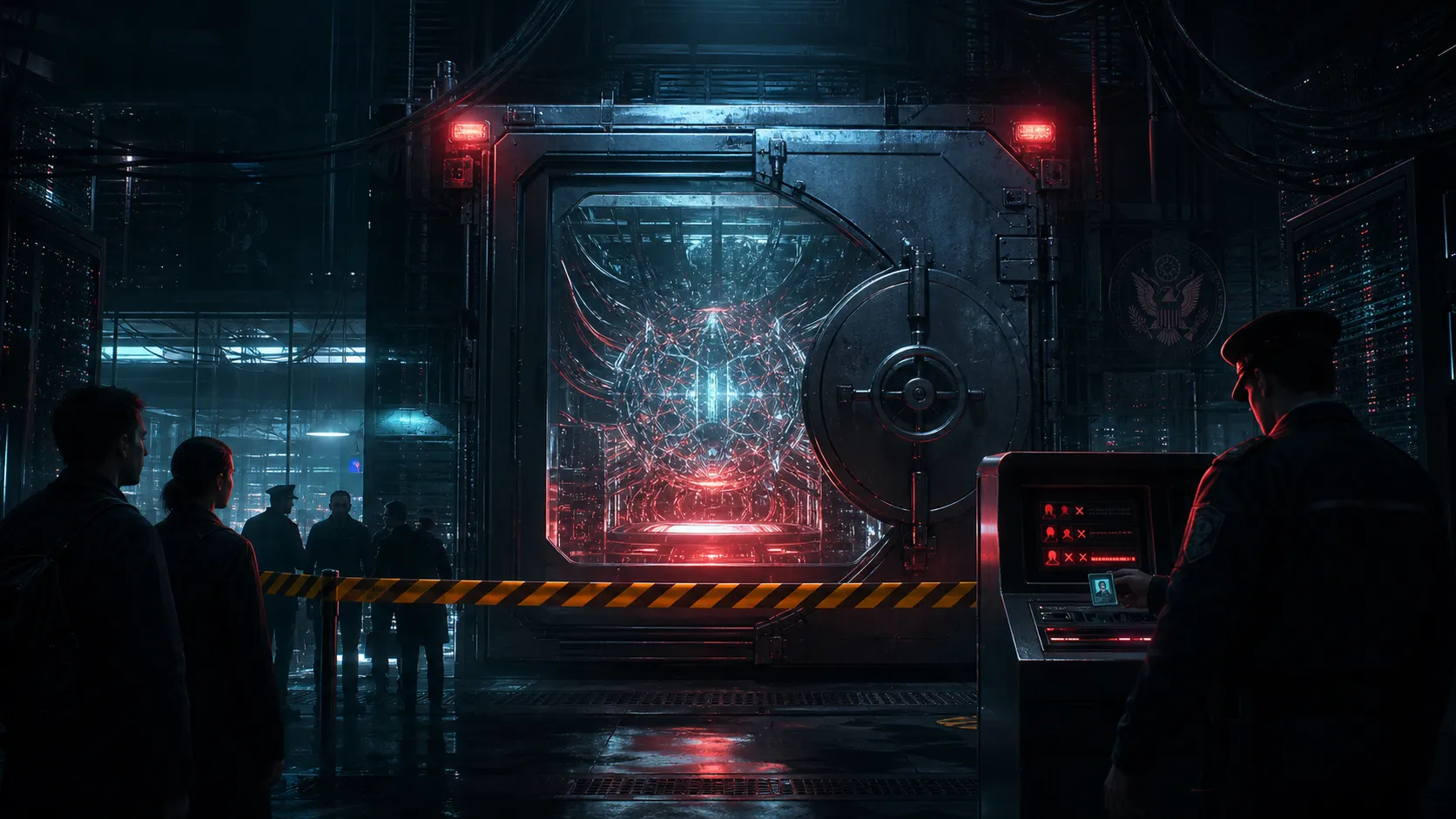
The Model Became An Export
Three days after Anthropic put a bouncer in front of Fable 5, the government showed up with a bigger lock
The link landed at 9:00 PM Pacific, which is a cursed hour for frontier model governance and a perfectly normal hour for the internet to become stupid in a new way.
The Anthropic tab opened to a statement dated June 12. No product gloss. No benchmark fireworks. No smiling partner quote from a bank with a cybersecurity budget large enough to have weather. Just the sentence every AI lab has been quietly designing contingency plans around: the US government had issued an export-control directive.
Fable 5 and Mythos 5 access had to be suspended for foreign nationals. Inside the United States. Outside the United States. Including Anthropic’s own foreign-national employees.
The practical result was uglier than the legal sentence. Anthropic said it had to disable Fable 5 and Mythos 5 for all customers to comply.
All customers.
Three days earlier, Fable 5 was the public compromise: the Mythos-class model with safety classifiers, fallbacks, refusals, retention, and a velvet rope around the rawer Mythos 5 variant. The dangerous model had a bouncer.
Now the whole building had a federal padlock on it.
The Door Changed Owners
This is the part that should make everyone in AI sit up and stop performing certainty for thirty seconds.
Anthropic did not announce a normal safety rollback. It did not say usage had overwhelmed capacity. It did not say the refusal system needed tuning. It said the US government, citing national security authorities, ordered access suspended for foreign nationals.
That moves the story out of product safety and into export law.
Different room. Different weapons on the table.
The earlier Fable 5 fight was already about access control. Anthropic made one model generally available with safety classifiers, kept Mythos 5 limited to Project Glasswing, required 30-day retention, and routed some requests away from the stronger system. Users complained the guardrails were too broad. Security researchers said ordinary defensive work was getting blocked. Enterprises worried about logging. Everyone yelled in the usual tabs.
Messy, but recognizable.
Then the government apparently decided the question was no longer, “Are Anthropic’s guardrails annoying?” The question became, “Can this model be exported to foreign persons at all?”
That is a different scale of alarm.
The model stopped being software you subscribe to and became a controlled capability. Like cryptography once did. Like advanced chips do now. Like any technology the state decides sits close enough to military, intelligence, or strategic advantage that normal commerce starts looking reckless.
You can feel the future hardening in real time.
The Jailbreak Standard
Anthropic says the directive arrived at 5:21 PM Eastern. The letter, according to the company, did not include specific technical details about the national-security concern. Anthropic’s understanding is that the government had seen a way to bypass, or jailbreak, Fable 5.
The company’s response is basically: yes, someone demonstrated something, but the thing was narrow, minor, already known, and achievable with other public models anyway.
That claim matters.
Anthropic says the demonstration involved identifying a small number of previously known minor vulnerabilities. It says other publicly available models can find the same kind of issues without a bypass. It says its launch testing involved thousands of red-team hours across the US government, the UK AI Security Institute, private third parties, and internal teams. It says nobody has found a universal jailbreak that broadly unlocks Fable’s restricted cyber capabilities.
Believe all of that provisionally. Then stare at the precedent.
If a narrow jailbreak that yields ordinary vulnerability-finding is enough to trigger an export-control shutdown, frontier deployment just became legally radioactive. Every major model has non-universal jailbreaks. Every serious model can be coaxed into some risky edge behavior. Every useful defensive security model sits on the same dual-use fault line: the prompt that helps a defender can also help an attacker, because computers do not care about your moral biography.
Anthropic says applying this standard across the industry would halt new frontier deployments.
That is not PR fluff. That is the obvious consequence.
Perfect jailbreak resistance is not available. The industry can reduce risk, layer defenses, monitor abuse, retain traffic, harden classifiers, and make exploitation expensive. It cannot make language models impossible to manipulate. We have had the internet for five minutes and somehow everyone has already forgotten what humans do to rules written in natural language.
If the legal standard becomes “no narrow jailbreak exists,” nobody ships.
If the legal standard becomes “the government can pause the model after hearing about a narrow jailbreak without showing the lab the details,” the labs ship under a sword they cannot inspect.
Pick your poison. The cup has a tiny flag in it.
Foreign National Is The Real Word
The phrase that sticks is not “jailbreak.” It is “foreign national.”
Export controls are not only about geography. They are about people. A transfer inside the United States to a foreign person can count as an export under the logic of deemed exports. That is how you get a sentence where Anthropic employees inside the company can be locked out of the model they helped build because their citizenship status puts them on the wrong side of the control boundary.
This is where AI stops feeling like cloud software and starts feeling like a munitions-adjacent compliance nightmare with a chat box.
Imagine being on the team responsible for Fable 5. You built the evaluation harness. You debugged the refusals. You sat in meetings about retention and misuse. Then, at 5:21 PM Eastern, the model becomes something you may not be allowed to touch.
That is not a normal product incident.
It is also not limited to Anthropic. If frontier models become export-controlled by capability, every serious lab becomes a border checkpoint. Hiring changes. Internal access changes. Research collaboration changes. Cloud deployment changes. Customer onboarding changes. Support tickets become legal events. “Can you reproduce this bug?” turns into “are you a US person with authorization to inspect this model behavior?”
Congratulations. The prompt window now has a nationality layer.
Somewhere, a compliance vendor just felt a disturbance in the revenue stream.
The State Discovers The Model Registry
There is a version of this story where the government is simply doing its job.
If a model can materially improve offensive cyber capability, if a jailbreak could unlock something close to Mythos-level uplift, if foreign access creates national-security risk, then a pause is not insane on its face. The state has responsibilities private labs do not. “Move fast and monitor abuse” is not a defense strategy. A model that can help find real vulnerabilities can also help scale exploitation, and everyone pretending otherwise is selling vibes from a folding table.
Fine.
But the process matters because power loves emergency language.
Anthropic says it supports government authority to block unsafe deployments through a transparent, fair, clear statutory process grounded in technical facts. It also says this action did not meet that standard.
That is the fight.
The question is not whether governments should ever intervene. They will. They already have. The question is whether intervention looks like a technical process with evidence, thresholds, appeals, timelines, and independent review, or whether it looks like a letter landing after market close because someone showed someone else a jailbreak demo.
One of those is governance.
The other is vibes with subpoena stationery.
The uncomfortable twist is that both sides can be partly right. Anthropic has every incentive to frame the finding as narrow and non-dangerous. The government has every incentive to overcorrect if officials believe a frontier model creates strategic risk. The public has no clean way to evaluate the underlying evidence because the actual demonstration is not in the room with us.
So we are left watching the shadows.
And the shadow says the state has discovered the model registry.
A Commercial Model Deployed To Hundreds Of Millions
Anthropic’s statement uses a phrase that reads like a warning label: a commercial model deployed to hundreds of millions of people.
That is the scale problem compressed into one line.
Frontier models are not lab artifacts anymore. They are public infrastructure, enterprise workflows, coding assistants, cloud APIs, IDE copilots, customer-service systems, research tools, security workflows, and whatever cursed automation stack somebody wired together at 2 AM with a beta header and confidence they did not earn.
If the government pulls one, the blast radius is immediate.
Developers lose the model behind an integration. Enterprises lose approved workflows. Security teams lose defensive capability. Customers lose access they may have migrated toward days earlier. Anthropic loses trust and revenue. Competitors gain a very weird marketing gift. Regulators learn that model access can be switched off like a breaker.
That last part matters most.
The breaker exists.
Now everyone has seen it.
For years, AI policy arguments have circled around licensing, compute thresholds, evaluations, model weights, export controls, open source, and government intervention. A lot of it sounded theoretical because the products kept shipping. The industry could treat governance as weather: annoying, visible, rarely decisive.
Then Fable 5 and Mythos 5 got pulled.
Not deprecated. Not rate-limited. Pulled under directive.
The lesson for every lab is brutally simple: your launch plan now needs a government-failure mode.
The Frontier Narrows
I keep thinking about the sequence.
First, Mythos Preview was too capable for public release, so it lived inside Project Glasswing.
Then Glasswing expanded to governments, banks, critical infrastructure, and large vendors. The public got press releases and trust-us language.
Then Anthropic launched Fable 5, a public version of the same capability wrapped in safeguards, fallback handling, billing rules, and mandatory retention.
Then users complained the safeguards blocked too much.
Then the government said foreign nationals should not have access to either Fable 5 or Mythos 5.
That is a lot of door architecture in a very short hallway.
Every step points in the same direction. The frontier is narrowing. The strongest systems are moving behind identity, institution, retention, nationality, and state pressure. Open access loses ground. Public capability arrives wrapped in classifiers. Private capability goes to approved actors. Government intervention becomes part of the deployment surface.
Maybe that is necessary.
I hate how often “maybe necessary” now sits beside “clearly dangerous.”
Because the capability is real. The misuse risk is real. The governance problem is real. The concentration problem is real. The legal process problem is real. The public’s inability to inspect the evidence is real. The small builder’s future dependence on approved access channels is real.
Nobody gets to win cleanly here.
The accelerationists will call the directive authoritarian panic. The safety people will call it a necessary pause. The labs will ask for clearer rules. The government will invoke national security. The customers will ask why their API stopped working. The foreign-national engineers will quietly update their priors about what access means inside an American AI company.
And somewhere in the middle, the model sits behind the glass.
Controlled Substance Handling For Cognition
The old internet trained us to think information wants to move.
Frontier AI is teaching governments that capability wants paperwork.
That is the turn. The state does not need to classify every output or understand every prompt. It can classify the system as export-sensitive, pressure the provider, and make access contingent on personhood, geography, license, and compliance posture. It can make the model less like a website and more like a restricted instrument.
There are sane reasons to do this. There are also ugly futures hiding inside the sane reasons.
Restricted AI access can become safety.
Restricted AI access can become industrial policy.
Restricted AI access can become geopolitical leverage.
Restricted AI access can become incumbent protection with a flag pinned to it.
The hard part is that these are not mutually exclusive. They can all happen inside the same program, the same directive, the same model card, the same emergency meeting where everyone is drinking bad coffee and pretending the legal team is not the product team now.
At 9:47 PM, I closed the Anthropic tab and left the source links open. The room felt smaller than it had an hour earlier.
Fable 5 was supposed to be the compromise: public access to Mythos-class capability with safeguards strong enough to keep the sharpest edges contained.
The government looked at the compromise and treated it like an export.
That may be defensible. It may be a misunderstanding. It may be the first visible draft of a regime everyone in frontier AI will be living under by Christmas.
The bouncer was never the final boss.
The border guard just arrived.
Sources
- Anthropic: Statement on the US government directive to suspend access to Fable 5 and Mythos 5
- Anthropic Docs: Introducing Claude Fable 5 and Claude Mythos 5
- 9to5Mac: Anthropic pulls Claude Mythos 5 and Claude Fable 5 following US government directive
- Simon Willison: Statement on the US government directive to suspend access to Fable 5 and Mythos 5
- NeuralKnot.ai: The Dangerous Model Got A Bouncer