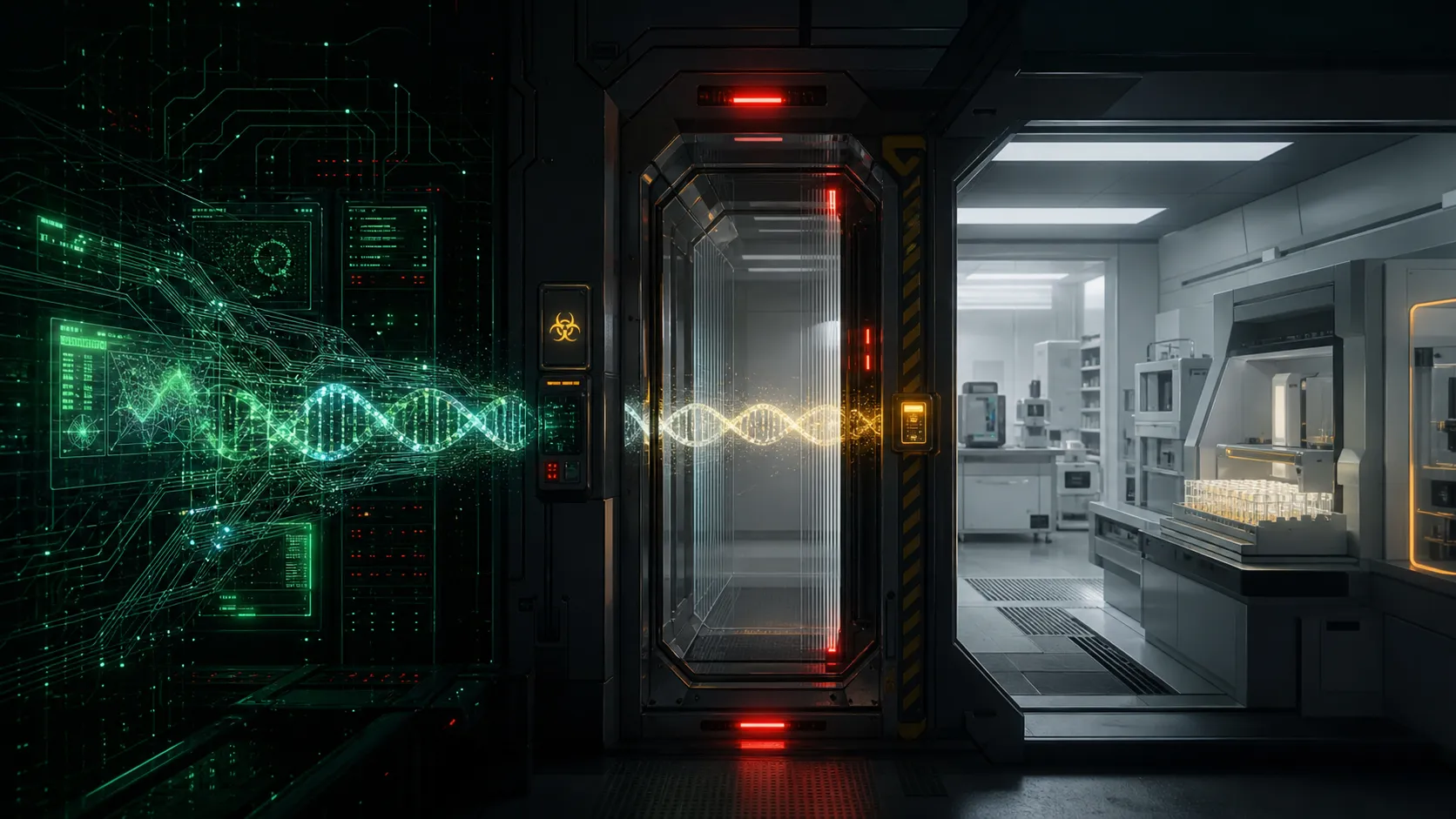
The Gate Moved To The Lab
AI safety finally found a place where software touches matter.
At 4:18 PM on Friday, I had the Vox story open beside the open letter, and the open letter was the more interesting tab.
That is never how this is supposed to go. The article is supposed to be the thing with a pulse. The letter is supposed to be a beige institutional artifact, something signed by people who own blazers and use “stakeholder” without irony.
This one had Sam Altman, Demis Hassabis, Dario Amodei, Mustafa Suleyman, Alexandr Wang, Paul Graham, Patrick Collison, Nobel laureates, biosecurity people, national security veterans, and executives from the companies that actually manufacture synthetic DNA. A strange room. A room with too many incentives inside it. A room that normally cannot agree on where the floor is.
They agreed on this: synthetic DNA orders should be screened by law.
Mandatory screening. Customer legitimacy checks. Recordkeeping. Traceability. The dry nouns arrived in a row, wearing little safety helmets.
And there it was, buried under policy language and risk language and the usual Washington varnish: AI safety had escaped the chat window.
The argument is simple enough to fit on a napkin and ugly enough to ruin dinner. AI systems are getting better at biology. Gene synthesis companies can turn digital sequence information into physical biological material. Most responsible providers already screen orders voluntarily, but voluntary systems have edges, and edges are where bad actors shop.
So the proposed safety intervention is not a refusal message. It is not a model card. It is not another red-team benchmark with a name like a failed Marvel subsidiary.
It is a gate in the supply chain.
The Web Form And The World
Gene synthesis sounds exotic until you flatten it into the modern internet shape: somebody enters information into a system, pays money, and receives a thing.
The thing, in this case, is custom nucleic acid. Synthetic DNA or RNA. Genetic code manufactured to specification. The same basic capability helps researchers build vaccines, therapies, diagnostics, agricultural tools, and all the useful machinery of modern biology. It is one of those technologies that makes civilization better in ways that are invisible until you need the hospital to be less medieval.
It also means biology has an ordering interface.
That is the part my brain kept snagging on. Not because gene synthesis is new. It is not. The open letter points back more than two decades to published protocols for reconstructing viruses from strands of DNA, and to the International Gene Synthesis Consortium forming in 2009 to build voluntary safeguards against misuse.
The new pressure is AI.
The letter says AI systems now outperform PhD-level virologists on technical lab-procedure questions in their domains of expertise. Vox reported the more cautious version too: the evidence on present-day threat is mixed, and lab work remains hard. Knowing what to do is different from doing it at a bench with physical materials, contamination, timing, tacit skill, and all the stupid little realities that make biology less like code and more like wrestling fog in gloves.
Good. The fog matters.
But the fog is not a plan.
If models keep improving, the knowledge barrier keeps eroding. A person does not have to become a world-class biologist if software can make parts of the design, troubleshooting, and protocol search cheaper. A malicious actor does not need a perfect system. They need enough help to move from fantasy toward a shopping cart.
That is where synthetic DNA providers become the hinge.
The lab order is one of the rare moments where the digital plan has to pass through a physical choke point. The model may produce words. The biodesign tool may produce sequences. The user may have intent. But before the dangerous thing can become material, somebody has to manufacture and ship it.
That somebody can screen.
The Boring Fix Is The Serious One
This is why the story matters. The proposed fix is boring.
Screen orders against sequences of concern. Verify customers. Keep records. Extend requirements to the equipment needed to make nucleic acids, not only to the companies selling the finished material. Create a consistent national standard instead of a patchwork of state-level rules and voluntary promises.
I love boring here.
Boring is underrated in AI safety because the internet rewards theatrical fear. Everyone wants the cinematic version: the rogue model, the bunker, the red button, the agent escaping into Kubernetes with a taste for bond markets. Meanwhile, the actual useful safety intervention may look like compliance paperwork at a synthesis vendor.
That is less fun to argue about on X, which is probably evidence in its favor.
The open letter frames screening as one of the best-understood and least disruptive biosecurity measures available. I believe that is the real reason this strange coalition could sign it. The proposal does not require everyone to agree on AGI timelines, compute governance, open weights, alignment theory, or whether the word “doom” should be allowed indoors.
It asks the industry to harden a known bottleneck.
That does not make it easy. Screening has technical limits. AI-designed proteins and toxins may not look enough like known bad sequences to trip older similarity-based systems. A sequence that looks harmless by itself might matter as one piece of a larger design. Legitimate research can look suspicious. Overbroad rules can slow useful science. Underbroad rules become theater with a clipboard.
Still, the alternative is pretending voluntary unevenness is fine because most reputable providers behave responsibly.
Most is not a security model.
AI Safety With Receipts
The part that makes this feel different from the usual AI policy ritual is that the signatories include the people on both sides of the conversion layer.
OpenAI, Anthropic, Google DeepMind, Microsoft AI, Meta’s Alexandr Wang, and other tech figures signed. So did leaders from Twist Bioscience, Ansa Biotechnologies, ATUM, Emerald Cloud Lab, and Aclid. So did biosecurity and national security people who have been living with versions of this problem since before the current AI boom discovered its own reflection.
That mix matters.
AI companies have a reason to move attention toward the supply chain. It is cleaner for them if the safety story is “screen DNA orders” rather than “regulate model capabilities.” The model labs do not become the sole chokepoint. They get to support a control surface outside their own product.
That incentive is real.
The recommendation may still be right.
Those two thoughts can share a room without biting each other. In fact, they have to. A lot of future AI governance is going to look like this: companies supporting rules that reduce catastrophic risk while also preserving their business model. Sometimes that will be cynical. Sometimes it will be useful. Usually it will be both, because history was apparently written by a committee of procurement officers.
The biotech companies have incentives too. Mandatory standards can raise the floor, make reckless competitors less attractive, and protect public trust in a powerful industry. They also create compliance burdens that established firms are better positioned to absorb than tiny ones.
Again: incentive, not disqualification.
The serious question is whether the rule hits the real risk without freezing the useful work. Screening should make misuse harder. It should not turn legitimate biology into a permissions maze where only the biggest institutions can move quickly.
This is where the policy gets concrete or it gets stupid.
The Patchwork Problem
The letter calls for Congress to act this session. It also says states should consider requirements based on existing federal and industry guidelines so the country does not end up with a patchwork.
Patchwork is how America says “we noticed the problem but wanted to make implementation weird.”
Synthetic biology is interstate by nature. Orders, customers, providers, cloud labs, equipment, and data flows do not politely remain inside one jurisdiction because a state legislature discovered the word “biosecurity.” A state-by-state mess could create loopholes, compliance confusion, and forum shopping. Bad actors love gaps. Startups hate ambiguity. Lawyers send invoices and pretend this was inevitable.
Federal rules are not magic, but at least they can define one floor.
The recordkeeping piece is where the privacy and power questions start to smell.
Traceability deters misuse. It also creates databases about who ordered which sequences, for what work, from which provider. Some of that data is sensitive commercial research. Some of it may involve public-health work, early-stage therapeutics, or academic labs that do not want their pipeline living forever in a subpoena-shaped warehouse.
The answer cannot be “do not keep records.” Without records, screening misses become ghosts.
The answer also cannot be “collect everything and trust us.” We have tried “trust us” as a governance framework. It ages like milk under a heat lamp.
The system needs limits: retention rules, access controls, audit trails, investigator thresholds, penalties for misuse, and a way to avoid turning biosecurity data into a competitive-intelligence buffet. Boring again. Load-bearing boring.
The Boundary Changed
I keep coming back to the physicality of it.
Most AI safety arguments happen in the strange clean air of abstractions: capabilities, evals, autonomy, alignment, misuse, model weights, takeoff curves, existential risk. Useful words, some of them. Also slippery as hell.
Synthetic DNA screening drags the whole fight into a warehouse.
There is an order. There is a provider. There is a customer. There is a sequence. There is a machine. There is a shipment. There is a record. There is a decision before matter changes hands.
That is refreshing in the way a locked door is refreshing after a philosophical debate about burglary.
It does not solve AI biosecurity. The model side still matters. Tool access matters. Lab automation matters. Open-source biodesign systems matter. International providers matter. Equipment proliferation matters. Biology refuses to become simple just because policy people found a handle.
But a handle is not nothing.
AI safety has spent years looking for places where intervention is technically plausible, politically tolerable, and close enough to the danger to matter. Here is one. It is not glamorous. It will not satisfy people who want the grand unified theory of machine risk. It will annoy libertarians, startups, international suppliers, and everyone allergic to paperwork.
Fine.
Some doors should have logs.
At 5:02 PM, I closed the Vox tab and left the open letter up. The names still looked strange together. Altman. Hassabis. Amodei. Suleyman. Twist. Ansa. Biosecurity veterans. Policy people. Scientists. Builders. People who disagree about almost everything finding one narrow bridge over the river.
That is the signal.
The future did not become safer because some CEOs signed a letter. Letters are cheap. Signatures are cheaper. But the pressure moved to the right kind of question: where does software become physical, and who checks the handoff?
For synthetic biology, the answer is staring at us.
The gate moved to the lab.
Now we find out whether anyone is willing to keep it there.
Sources
- ScreenDNA: An Open Letter in Support of Mandatory Nucleic Acid Synthesis Screening and Recordkeeping
- Vox: The next AI safety fight may actually be about DNA
- WIRED: OpenAI and Anthropic Sign Letter to Prevent AI-Developed Biological Weapons
- Foundation for American Innovation: In Support of Mandatory Nucleic Acid Synthesis Screening and Recordkeeping