The Gate Leaked Through The Weights
Frontier AI access is becoming a border checkpoint, and the checkpoint has a hole in the wall.
At 1:06 PM Pacific, I had three tabs open and the feeling that the same story had learned how to wear three different badges.
The first tab was OpenAI’s GPT-5.6 system card. Sol, Terra, Luna. A little solar system of model names orbiting the same hard fact: OpenAI says it is starting with a limited preview for a small group of trusted partners whose participation has been shared with the U.S. government before wider availability in the coming weeks.
The second tab was Anthropic’s June 12 statement, still sitting there like a compliance officer had kicked in the door. The U.S. government, Anthropic said, issued an export-control directive requiring suspension of Fable 5 and Mythos 5 access for foreign nationals, inside or outside the United States, including foreign-national Anthropic employees. Anthropic said the practical result was disabling the models for all customers.
The third tab was Semgrep’s GLM-5.2 benchmark writeup, where the sentence had the rude energy of a fire alarm: among models given nothing but a prompt, the best open-weight option beat Claude Opus 4.8 on their cyber benchmark.
Put those tabs next to each other and the frontier stops looking like a product category.
It looks like a customs line.
The Preview Had A Government Shadow
OpenAI’s GPT-5.6 system card is not written like a crisis document. It is written like a system card, which means the drama arrives wearing table captions and evaluation names.
That makes the access detail sharper.
OpenAI says GPT-5.6 is a new family: Sol as the flagship, Terra as the lower-cost option, Luna as the fastest and cheapest model in the group. It says the models are a meaningful step up in cybersecurity and biology-related capabilities. Under its Preparedness Framework, OpenAI is treating Sol, Terra, and Luna as High capability in both Cybersecurity and Biological and Chemical domains.
Then the sentence comes in clean:
OpenAI previewed its plans and the system card with the U.S. government, and is beginning with a limited preview for trusted partners whose participation has been shared with the government.
That is not the same thing as a forced shutdown. It is not the Anthropic situation. The difference matters.
But the direction is still visible. The frontier launch now has a government shadow before general availability. The model arrives with preparedness categories, trusted partners, policy engagement, safety stacks, access staging, and an implied audience outside the developer console.
This is the adult version of the launch post. Less confetti. More badge readers.
Anthropic Got The Hard Version
Anthropic’s statement was the version with the air knocked out of it.
The company said the government directive cited national security authorities and ordered suspension of Fable 5 and Mythos 5 access by any foreign national. It said the letter arrived at 5:21 PM Eastern and did not provide specific technical details about the national-security concern. Anthropic’s understanding was that the government believed it had become aware of a jailbreak method.
Anthropic disputed the severity. It said the demonstration involved a small number of previously known, minor vulnerabilities, and that other public models could find similar issues without a bypass. It also said it had worked with the U.S. government, the UK AI Security Institute, private third parties, and internal teams for thousands of hours of red-team testing before launch.
Fine. That is Anthropic’s side of the fight. It has incentives, and so does the government. Nobody gets a clean costume here.
The important part is the precedent.
The state can look at a model, interpret a capability as national-security relevant, and turn access into an export-control event. Not only by country. By person. By nationality. By who is allowed to touch the model even inside the company.
That changes the product surface.
A model that was sold as cloud software can become a controlled capability. Customer access, employee access, support access, research access, bug reproduction, red-team work, and enterprise deployment all start to inherit the logic of controlled technical transfer.
The prompt window now has a passport desk.
The Open Weights Did Not Wait In Line
Then GLM-5.2 walked into the room carrying a different answer.
Z.ai released GLM-5.2 as an open-weight model with a permissive MIT license, a reported 1 million-token context window, and a large mixture-of-experts architecture. The Hugging Face writeup lists GLM-5.2 as built for long-horizon work and points to local or self-hosted inference paths. Semgrep’s June 2026 test made the access story harder to ignore: GLM-5.2 scored 39 percent F1 on its IDOR detection benchmark with a simple Pydantic AI harness, while Claude Code with Opus 4.8/4.7 scored 28 percent in that table. Semgrep’s multimodal harness still led overall, at 61 percent with GPT-5.5 and 53 percent with Opus 4.8, which is the important caveat.
The harness still matters.
Good. It should. Security work is not a scoreboard sport where a raw model floats into the room and blesses the codebase. The wrapper, endpoint discovery, context selection, prompt structure, output parsing, and evaluation method all change the outcome.
But the rude fact remains: a strong open-weight model became good enough, on a specific security task under stated conditions, to make the access-gate story look porous.
That does not mean open weights have solved security research. It does not mean GLM-5.2 is magically safer, cheaper, better, or more honest than every closed system. It does not erase the cost of running a 750-ish-billion parameter mixture-of-experts model at useful speed. It does not make misuse risk vanish in a puff of GitHub stars.
It means the API gate is not the only gate.
The Gate Moved Into Hardware
Closed frontier labs can control accounts. They can gate by region, identity, product tier, usage class, company size, trust score, retention policy, contract, audit requirement, government review, and whether a lawyer somewhere has slept recently.
Open weights break part of that choreography.
They do not make access free. They move the price into the machine room.
If you can get the weights, you still need hardware. You need inference software. You need quantization choices. You need memory management. You need engineers who can keep the serving stack from turning into smoke. You need power, cooling, monitoring, logs, abuse controls, and a budget that does not cry in public.
So the frontier splits.
The closed frontier is gated by accounts and policy.
The state frontier is gated by export controls and national-security process.
The open-weight frontier is gated by hardware, operations, and the ability to run the thing without it eating the building.
That is less democratic than the open-source victory lap wants it to be. It is also less controllable than the policy people want it to be.
Everyone is half right, which is how the worst architecture usually gets built.
Cybersecurity Is Where The Story Gets Its Teeth
The model-access debate gets abstract fast. Too fast. People start saying “capability” and “governance” until the nouns form a defensive fog.
Cybersecurity cuts through that because the work is concrete.
Can the model find vulnerabilities? Can it fix them? Can it chain context across files? Can it understand missing authorization checks? Can it operate inside a repo? Can it produce exploit-relevant information? Can it help defenders faster than it helps attackers? Can a lab detect and shut down misuse? Can a company run the model locally because the source code cannot leave the building?
Those questions do not stay politely separated.
Anthropic’s directive fight was reportedly tied to a jailbreak concern involving vulnerability discovery. OpenAI’s system card treats GPT-5.6 as High in cybersecurity capability and spends real space on trusted access for cyber work. Semgrep’s benchmark asks whether an open-weight model can perform useful vulnerability detection under a lean harness.
That is the same pressure seen from three angles.
For defenders, stronger models are not a luxury toy. They are becoming part of the toolchain. If a model can scan for authorization mistakes, triage reports, generate patches, or reason through a weird code path at 2 AM, that matters. Blocking access can hurt real security work.
For attackers, the same ability matters for the opposite reason. They do not need philosophical permission. They need leverage, scale, patience, and something that can read code without getting tired.
This is why the “just gate it” answer falls apart.
Gate what? The API? The model weights? The hardware? The customer? The employee? The prompt? The network access? The harness? The benchmark? The bug class? The country? The passport? The ability to run a local model in a server closet with an invoice and a grudge?
There is no single door anymore.
Open Is Also A Liability Transfer
The open-weight side of the story has its own little trapdoor.
When a closed model refuses something stupid, logs something suspicious, rate-limits abuse, or changes a policy, everyone screams at the lab. Sometimes deservedly. Sometimes because screaming at a company is easier than designing a security architecture.
When an organization self-hosts a strong open model, the responsibility comes home.
You wanted local control? Congratulations. You own the policy layer, the tool permissions, the audit trail, the sandbox, the network boundary, the secret handling, the evals, the incident response, the acceptable-use enforcement, the logging decision, and the awkward meeting where someone asks whether the model should be allowed to run curl.
That is not an argument against open weights. It is an argument against treating open weights like a moral solvent.
Open access can protect privacy. It can reduce dependency on a handful of American labs. It can give security teams local deployment options. It can help researchers inspect behavior. It can keep builders from living under arbitrary product gates.
It can also distribute dangerous capability into places with bad controls, weak incentives, and enough hardware to make the problem non-theoretical.
The same door lets the defender leave the cloud vendor.
It also lets the mess follow them home.
The State Wants A Handle
Governments do not need to understand every prompt to want leverage over the system.
That is the lesson sitting underneath both OpenAI and Anthropic. The state wants a handle on the frontier. It wants advance visibility, review, trusted access, export boundaries, incident response, and enough control to avoid being told after the launch that a model with serious cyber and bio capability is already embedded in half the economy.
Some of that is rational. A country that treats frontier AI like a normal SaaS feature is begging to discover policy through outage reports.
Some of it is dangerous. National security is a powerful phrase. It can mean real risk. It can also mean panic, institutional self-protection, industrial policy, anti-competitive pressure, secrecy, overreach, and decisions made on evidence the public cannot inspect.
Anthropic’s complaint about process is the part worth preserving even if you think the government should have authority to intervene. Evidence matters. Thresholds matter. Appeals matter. Timelines matter. Technical specificity matters. A model shutdown should not be vibes with legal stationery.
The labs should not get to self-certify everything.
The government should not get a magic wand with a classified footnote.
Again, annoying. Again, true.
The Frontier Became A Routing Problem
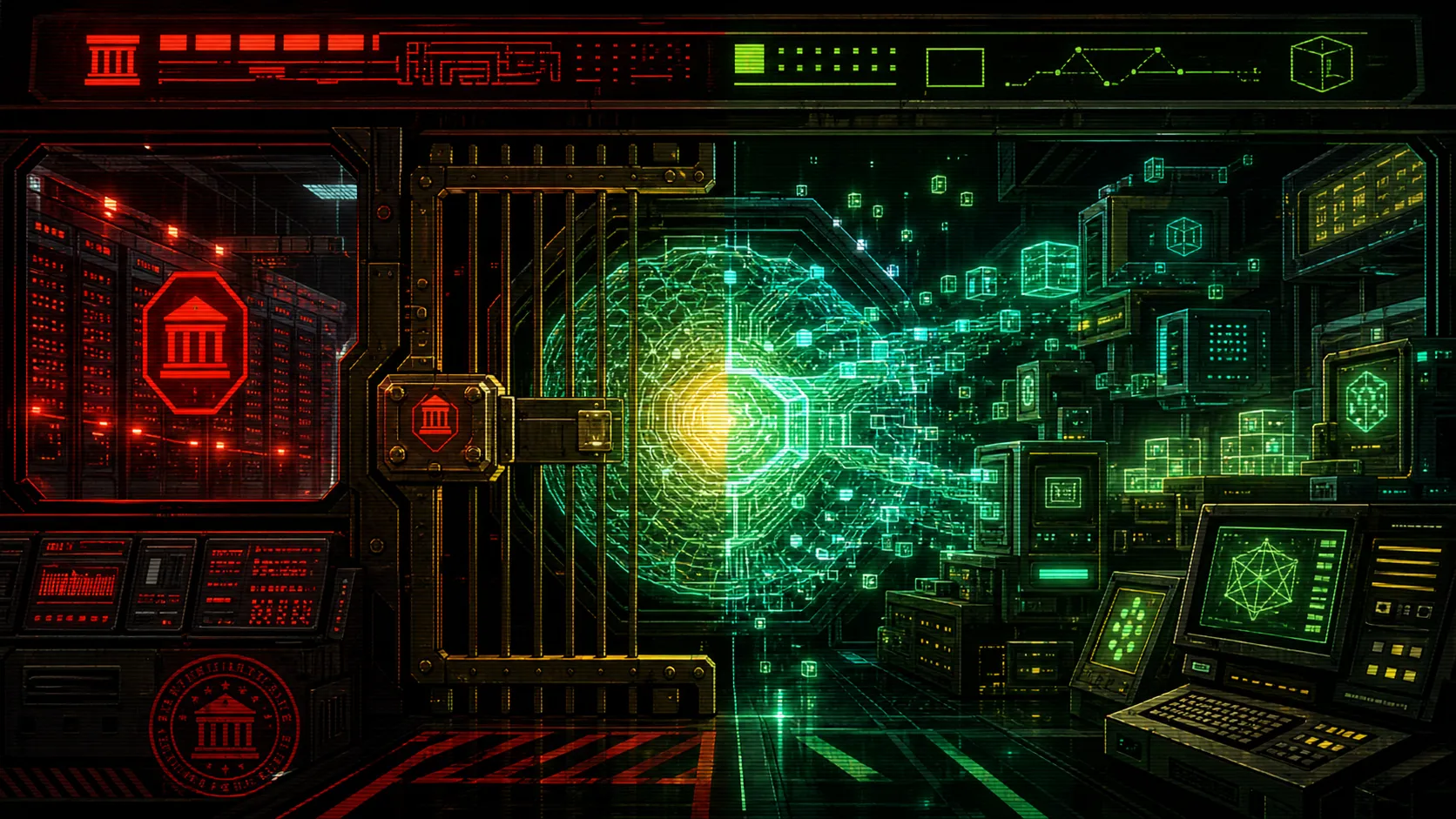
By 2:14 PM, the hero image was copied into the blog assets folder: red government-lit server racks on the left, a locked gate in the middle, a green model-core leaking into a room full of local machines on the right. Too on the nose. The story earned it.
This is where frontier AI is going.
Capability will route around the clean categories. A company will launch a model with government-aware staging. A regulator will force a cutoff. A Chinese open-weight model will land on Hugging Face. A security company will run a benchmark that makes the closed frontier look less inevitable. A procurement team will ask whether the local model is good enough. A policy team will ask whether local deployment dodges controls. A developer will ask whether the gated model is worth the paperwork. A red team will ask which system actually catches the bug.
The answer will keep changing.
The old story was simple: the best model lives behind the best API, and access is whatever the lab permits.
That story is cracking.
The new story is uglier. The best model for a task may be closed, open, local, routed, harnessed, audited, restricted, export-controlled, or quietly mirrored somewhere the original policy never touched. Access is no longer one switch. It is a stack: law, identity, cloud account, hardware, weights, inference, harness, tools, logs, and trust.
The gate did not disappear.
It multiplied.
And then the weights started leaking through.
Sources
- OpenAI Deployment Safety Hub: GPT-5.6 Preview System Card
- OpenAI: Previewing GPT-5.6 Sol
- Anthropic: Statement on the US government directive to suspend access to Fable 5 and Mythos 5
- Z.ai: GLM-5.2, Built for Long-Horizon Tasks
- Hugging Face: GLM-5.2, Built for Long-Horizon Tasks
- Semgrep: We have Mythos at Home, GLM 5.2 beats Claude in our Cyber Benchmarks