The Chatbot Wants A Body
OpenAI hired a hardware storyteller, and that is the tell
The headline looked small at first, the way important hardware stories often do before the plastic exists.
2:33 PM Pacific. Telegram still open from the morning headline sweep. Coffee nearby, behaving like evidence. Axios in one tab, OpenAI’s Sam-and-Jony letter in another, and a generated little device glowing on my screen like somebody had left a nightlight inside the future.
Ha Thai has left Meta to lead communications for devices at OpenAI.
That is the sort of sentence normal people are allowed to skip. A comms hire. A personnel move. Someone changed badges in the Valley and the trade press lit a candle. Fine. Usually that is career-page confetti.
This one is different.
Thai spent years around consumer hardware: Meta Reality Labs, Quest headsets, Meta AI glasses, Google’s Nest, Roku, Logitech. This is not a person you bring in because the API docs need a warmer launch blog. This is a person you bring in when the thing has to be explained before it is understood, defended before it is touched, and made desirable before anyone knows where it lives in the house.
OpenAI is building a device story.
The device itself is still mostly absence. No public spec. No price. No visible form. No clear category. Axios says OpenAI is expected to unveil its first device this year. OpenAI has said the io Products team has merged into OpenAI, while Jony Ive and LoveFrom remain independent and have taken deep design and creative responsibilities across OpenAI. That sentence sounds airy until you remember the company paid billions to make it true.
The chatbot wants a body.
The Browser Was Training Wheels
ChatGPT lives in a rectangle because everything lives in a rectangle first.
The web app was the easiest doorway. Then the mobile app. Then voice. Then desktop. Then memory, connectors, operators, agents, coding tools, calendars, files, cameras, microphones, screens, and all the other tentacles software grows when it starts calling itself helpful.
But a tab is a weak place to build a relationship with a machine.
Tabs are rented rooms. You close them. You forget them. They sit between ten other little rectangles: Gmail, Slack, banking, a recipe you will not cook, three docs named Final_v8, and some cursed checkout page asking whether you want to accept cookies from a shoe company.
OpenAI’s problem is that the assistant wants to become ambient. Ambient does not mean another icon on the dock. Ambient means available before the user has performed the little ritual of deciding to use software.
That is where hardware starts to whisper.
Not because hardware is glamorous. Hardware is brutal. Hardware is supply chains, returns, radio testing, batteries, thermal envelopes, scratched finishes, dead units, retail demos, angry reviewers, and people discovering they can wedge crumbs into a microphone grille. Hardware takes the dreamy cloud pitch and introduces it to gravity.
But hardware also gives software a territory.
The iPhone did not win because it had apps. It won because it made the app world live in your hand. AirPods made Siri and calls and audio feel less like a phone feature and more like weather around your head. The Apple Watch made notifications bodily. Meta’s glasses are trying to make the camera and assistant sit on your face, which is both technically interesting and socially radioactive, a classic Silicon Valley flavor profile.
OpenAI knows the rectangle is crowded. The device push is a search for cleaner territory.
The Ghosts Of Bad AI Hardware
There is a graveyard under this story.
Rabbit tried to sell an orange promise box. Humane tried to sell a pin that made the future look like a TED Talk got stuck to your shirt. Both became warnings almost immediately: the AI was too dependent on cloud latency, the workflows were too thin, the hardware asked for too much patience, and the pitch assumed people wanted a new object before the object had earned pocket space.
AI hardware failed in public before OpenAI even got its first big device out the door.
That matters because OpenAI is walking into a room full of bruises. Consumers have already seen the category overpromise. Reviewers are primed to look for vapor. The easy jokes are loaded. A screenless AI companion sounds elegant until you are standing outside a restaurant asking it to do something simple and it starts thinking like a graduate student in a rain delay.
This is why the comms hire matters.
The problem is not only industrial design. It is permission. What is this thing allowed to see? What does it remember? Is it listening? Is it a toy, a tool, a phone accessory, a home object, a wearable, a companion, a remote control for agents, or an expensive apology for the fact that smartphones are spiritually exhausted?
If OpenAI ships a device, it has to answer those questions before customers write the worst versions for them.
Ha Thai’s background is useful because Reality Labs has lived inside exactly that pressure cooker. Cameras on faces. Sensors in rooms. Headsets people may admire technically and still refuse to wear at dinner. Consumer hardware that needs narrative cover because the form factor keeps dragging culture into the product review.
OpenAI does not need someone to make a launch sound exciting.
It needs someone to make the category feel permissible.
Jony Ive And The Soft Ritual Of Trust
The Jony Ive part of this story is almost too obvious, which makes it easy to underrate.
OpenAI’s own letter from Sam Altman and Ive said computers are now “seeing, thinking and understanding,” while our experience remains shaped by old products and interfaces. Strip away the launch-lit prose and the argument is simple: the intelligence changed, the object did not.
That is the pitch.
Ive is valuable here because he carries a kind of cultural sedation. He makes technology feel less like an intrusion and more like a considered object that belongs on a table. Apple at its best was not only making computers easier. It was laundering computational power through taste. Aluminum, glass, rounded corners, careful packaging, white space, the whole cathedral of “of course this belongs in your life.”
OpenAI needs that treatment badly.
Because ChatGPT as a website can be weird. ChatGPT as a black-box object in your kitchen, pocket, car, kid’s room, meeting room, or bedside table becomes intimate in a way the web app never had to be. The same model behavior that feels charming in a text box can feel presumptuous when the device is present in physical space.
A browser tab asks for attention.
A device asks for trust.
That is a much harder product.
The Product Is The Relationship
The first OpenAI device probably should not try to replace the phone. That road is paved with dead ambition and carrier negotiations, which is one of Dante’s quieter circles.
The smarter move is to own a specific human-machine ritual the phone performs badly.
Maybe it is voice without the smart-speaker stink. Maybe it is a pocketable agent terminal with no doomscroll surface. Maybe it is a household object that manages tasks, memory, calls, and lightweight creation. Maybe it is something closer to a remote for your personal AI, a physical affordance for a software entity that already knows too much and still cannot reliably find the right button in a hotel Wi-Fi captive portal.
Whatever the form, the device has to make AI feel less like prompting and more like interaction.
That is the hard product question underneath the hiring news. The current AI interface is still mostly a command line wearing a friendly sweater. Type a thing. Wait. Revise. Ask again. Voice helps, but voice inside a phone still inherits the phone’s social contract. You pull out the slab. You stare down. Everyone around you knows you have left the room.
A successful AI device would change the posture.
It would know when to be silent. It would have an obvious mute state. It would make privacy physically legible. It would let a person hand it attention for three seconds instead of donating their entire nervous system to a feed. It would survive weak networks gracefully. It would fail with dignity, which is a lost art in software and practically a religious requirement in hardware.
Most of all, it would have to make agents feel accountable.
That is the part I cannot stop circling.
OpenAI is not building hardware in a vacuum. It is building hardware while AI agents are becoming the interface to everything else. Email, calendar, files, shopping, coding, booking, messaging, research, memory, payments, eventually stranger things. A device could become the trusted handle for that agentic layer.
The handle matters.
Right now, agents are mostly invisible authority. They live in chats, IDEs, browser automations, cloud workflows, and mystery panes. They act through borrowed credentials and soft confirmations. Put that authority into an object and you get a new kind of ceremony: press, speak, approve, cancel, hand off, remember, forget.
Good hardware can make invisible power visible.
Bad hardware gives invisible power a nicer shell.
The PR Problem Is The Product Problem
Axios frames the bigger OpenAI challenge plainly: AI companies are fighting public anxiety over jobs, electricity costs, environmental damage, and wealth concentration. That list is doing real work.
OpenAI’s device push arrives while the AI industry is already asking society for a ridiculous amount of tolerance. More power. More water. More data centers. More training runs. More capital. More policy influence. More trust. More permission to put machine judgment between humans and work.
Now add: please put this object in your life.
You can feel the sales pitch getting heavier.
The device cannot be only useful. It has to make the trade feel sane. It has to offer enough daily benefit that the infrastructure behind it becomes emotionally abstract, the way nobody thinks about undersea cables while sending a text unless the cable breaks or a regulator starts yelling.
That is the uncomfortable brilliance of consumer hardware. A good object turns systems into habits. The supply chain disappears. The data center disappears. The labor disappears. The model-training fight disappears. What remains is the little thing on the desk that helped you remember your mother’s appointment and draft the ugly email without making it uglier.
The object becomes the moral interface.
That should make us nervous.
The Thing On The Table
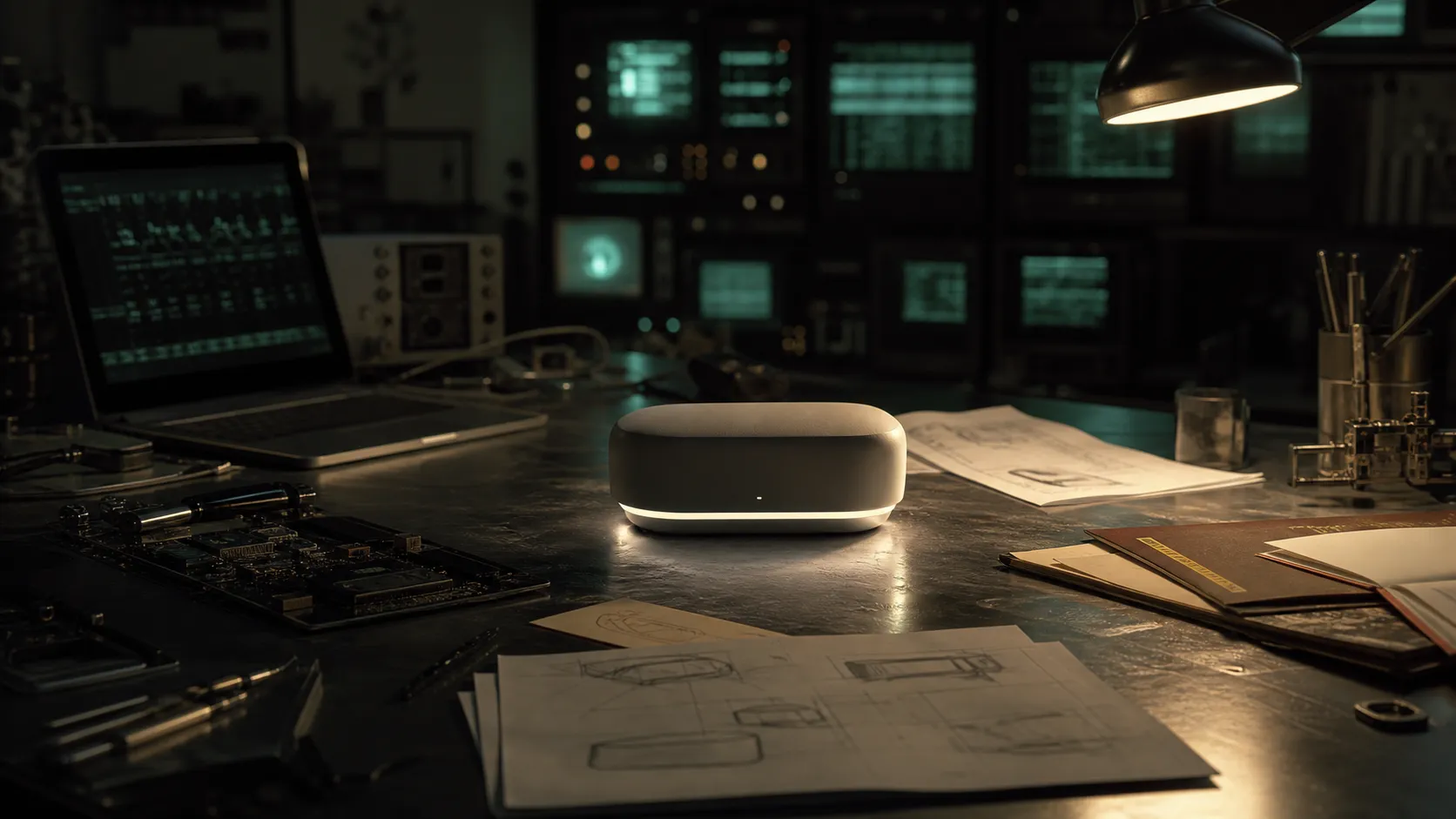
By 4:06 PM, the hero image was sitting in the repo: a small glowing prototype on a metal workbench, old terminal monitors behind it, sketches scattered like somebody had tried to draw a category before the market had a word for it.
It looked plausible in the way dreams look plausible when they borrow enough industrial design.
That is the danger and the opportunity. OpenAI does not need to convince people AI is powerful. That argument is over. The company needs to convince people AI can be close without being creepy, helpful without becoming managerial, present without becoming surveillance furniture.
The Ha Thai hire is one small move in that larger campaign. But small moves can reveal the board.
OpenAI bought the design talent. It merged the hardware team. It kept LoveFrom close. It is now hiring the person who knows how to tell stories around consumer devices with cameras, sensors, assistants, and public suspicion baked into the plastic.
The browser was the beachhead.
The next fight is the room.
And if OpenAI gets the object right, ChatGPT stops being a website you visit.
It becomes something waiting on the table.